Operation link optimization

Operation link generation
Automatic operation link generation is a function with the main objective to create a motion path between two operations that is free of any collision between the manufacturing devices (tool, robot, etc.) and the workpiece or other equipment. Further objectives, like for example a minimum cycle time, may be included in the functionality as secondary requirements.
The function will generate more complex paths than a direct connection between the operations.
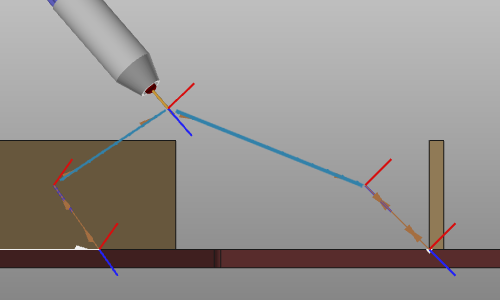
The function works on existing toolpath structures, where it:
-
Manipulates approach and retract positions, only if these position are not (in-) process related.
-
Creates additional positions within the operation link path itself.
The picture below shows schematically the solution that will be generated.
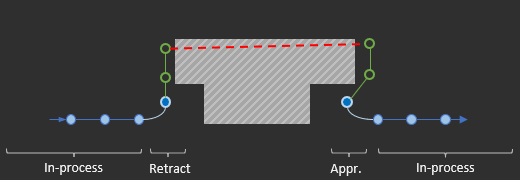 | 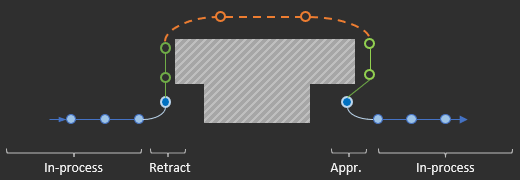 | |
| Before | After |
Conditions
Technology system configurations
Each technology has different boundary conditions and requirements. Different robot or machine types, their configuration and turn values (when applicable) and the preferred motion (PTP, lin, …) are of major importance to calculate the proper and expected link path. Taking this into account, there will be no general solution, based upon the workpiece geometry only. For each technology and manufacturing setup case, the system computes its own specific solution.
Dependency on linked operations
Operations can be modified or optimized with the various available functionality. It implies that the automatic operation link generation may not change the operations that it connects. This means that:
-
Positional coordinates, robot configuration and turn values of the last process point of the source operation and the first process point of the target operation will be retained.
-
It may be therefore necessary to change the configuration and turn values on the link path itself (depending on motion type capabilities).
External axes
Values of the external axes will be included in the calculation of the link paths. The axis values at the source operation’s last process point and the target operation’s first process point will be maintained. Even if these are modal and not explicitly specified, the value applied there is being retained.
Manual modifications
Toolpath positions, generated with the functionality, are editable manually.
-
Modified positions remain fixed and in that context will not be recomputed after update with the command.
-
Additional positions can be inserted in the link path.
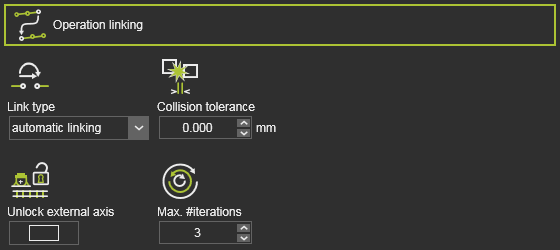
In the tech tab Operation linking of the Active program dashboard, the parameters to control the creation of the operation link can be set.
| Attribute | Description | Remark |
|---|---|---|
| Link type | The type of the operation link. | To enable the automatic generation, the type has to be set to automatic linking. |
| Collision tolerance | Defines the safety distance when generating the link path. | |
| Max. #iterations | Defines the maximum number of iterations that the path finding algorithm will run. | |
| Minimum gain | Defines the minimum that the quality metric value must improve between iterations. Otherwise, the path finding will end. | |
| Unlock external axis | Use of the entire range of the external axis values for the link path generation. | Off: The external axis value can only be changed within the interval given by start and end point of the link path. On: The external axis values are to be considered within the full range of each axis (i.e. are unlocked). |
Changes that are made here to the attributes require a regeneration of the link path by executing the command again.
Path g
The automatic operation link path generation uses a methodology of iterative steps to find the result. When it is executed, a panel appears to indicate the progress of the process.
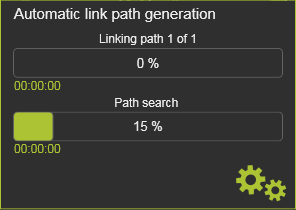
Link path state
The state of the automatic generation is kept and made visible in the Toolpath monitor dashboard.
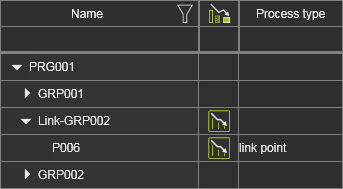
The column here indicates if the automatic link path generation process has been executed and what its status is.
 | Empty; no automatic link path has been generated. |
 | The automatic generation has been run and is still valid. |
 | The automatic generation has been run, but is outdated (i.e. overrun) because of other (additional) modification. |

