Prozesssimulationsobjekt

Prozesssimulationsobjekt
Das Prozesssimulationsobjekt (PSO) ist die Komponente oder ein Teil einer Komponente, auf die der Prozess einwirkt. Mit anderen Worten: Das PSO ist das Objekt, auf dem das Ergebnis eines Fertigungsprozesses berechnet und analysiert werden kann. In vielen Fällen handelt es sich dabei um (einen Teil) des Werkstücks, aber auch andere Ressourcen können durch einen Prozess beeinflusst werden.
Das PSO ist ein geometrisches Element, das von seiner zugehörigen Eingabegeometrie abgeleitet wird. Ein vordefiniertes Datenmodell bestimmt, wie dieses PSO erzeugt wird. Dies kann je nach Technologie und den zu analysierenden Prozesswerten unterschiedlich sein. Auf das Datenmodell und seine Attribute kann im PSO-Dashboard zugegriffen werden.
Auf diesem Datenmodell wird die Auswirkung des Prozesses während der Simulation berechnet. Das PSO wird verwendet, um die Ergebnisse der Simulation zu visualisieren und zusammen mit dem Werkstück zu speichern.
Das auf ein PSO angewandte Prozessmodell verfügt über mindestens einen physikalischen Parameter, der während der Simulation berechnet wird. Bei der Erstellung des PSO wird für jeden physikalischen Parameter dessen Anfangswert im PSO-Dashboard festgelegt, wie im folgenden Beispiel dargestellt. Zu jedem Zeitpunkt, vor, während oder nach der Simulation, kann dieser Anfangswert geändert oder der Ergebniswert aus der Simulation auf den Anfangswert zurückgesetzt werden.
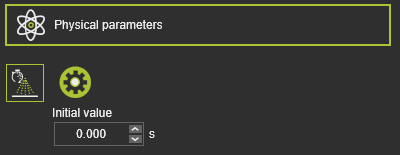
Die PSO-Definition und die aktuellen Simulationsergebnisse (können auch nur der Anfangswert sein) werden zusammen mit dem Werkstück gespeichert, wenn dieses Werkstück aus seiner Arbeitsumgebung heraus gespeichert wird. Bei der Arbeit an einem Projekt werden die PSO-Definition und deren Simulationswerte auf der Werkstückinstanz gespeichert, nicht im Originalwerkstück, wenn das Projekt gespeichert wird.
Verschiedene Fertigungsprozesse können unterschiedliche Datenmodelle zur Berechnung der Auswirkungen aufweisen. Die nachfolgend beschriebenen Datenmodelle wurden implementiert.
Oberflächennetz
Das PSO erstellt ein Oberflächennetz auf der ausgewählten Geometrie, das aus Knoten und dreieckigen Flächen besteht.
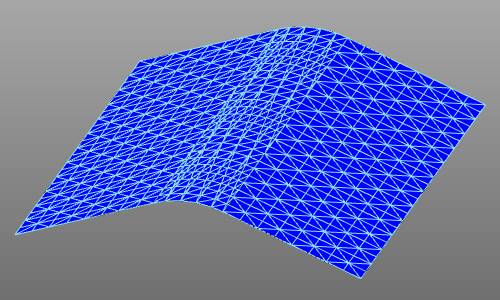
Der Mesh-Generator verwendet die folgenden Attribute:
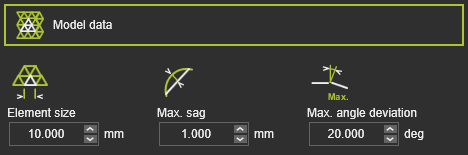
| Attribut | Beschreibung | Bemerkung |
|---|---|---|
| Elementgröße | Die maximale Kantenlänge eines Maschenelements (Facette). | Die Größe kann auf jeder Seite des Elements unterschiedlich sein. |
| Max. Durchbiegung | Die maximale Abweichung von der zugehörigen Eingabegeometrie. | Gilt sowohl für Oberfläche als auch für Begrenzung. |
| Max. Winkelabweichung | Der maximale Winkel zwischen benachbarten Maschenelementen. | Gilt über die Oberfläche und entlang der Randtangente. |

