Kinematisches Skelett

Referenzhandbuch \ Komponenten & Objekte
Kinematisches Skelett
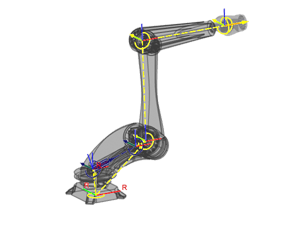
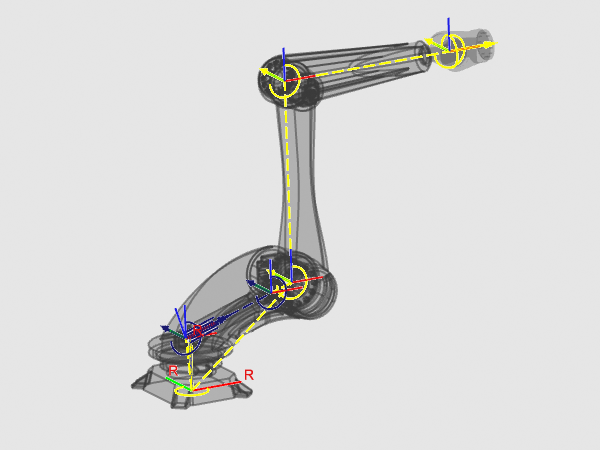
Die dynamische Fähigkeit einer Ressource wird durch ihr kinematisches Skelett definiert. Dieses kinematische Skelett ist eine Reihe von miteinander verbundenen Gelenken, die eine Kette bilden und die Bewegung von (Teilen der) Ressource steuern.
Ein Gelenk ist ein Rahmen, ein Koordinatensystem, mit mehreren vordefinierten Bewegungseigenschaften.
| Eigenschaft | Beschreibung |
|---|---|
| Koordinaten | Die Position und Ausrichtung des Gelenks. |
| Achse | Die Achse des Koordinatensystems, auf das sich das Gelenk bezieht. |
| Typ | The type of joint:  translation translation  rotation rotation |
| Elternteil | Das übergeordnete Gelenk oder der Wurzelrahmen zur Definition der Abhängigkeit im kinematischen Skelett. |
| Grenzen | Die maximalen und minimalen Werte der Gelenkbewegung. |
| Max. Geschwindigkeit | Die maximale Geschwindigkeit der Gelenkbewegung. |
| Max. Beschleunigung/Verzögerung | Die maximale Beschleunigung oder Verzögerung der Gelenkbewegung. |
| Verbinde nicht angetriebenes Gelenk | Die starre Verbindung eines nicht angetriebenen Gelenks mit dem übergeordneten angetriebenen Gelenk. |
Die Wurzel eines kinematischen Skeletts wird durch den Wurzelrahmen der Ressource festgelegt. Dieser Wurzelrahmen ist mit dem festen Teil der Ressource verbunden, von dem aus alle (relativen) Bewegungen abgeleitet werden.
Während der Simulation werden die exakten Werte der angetriebenen Gelenke innerhalb eines kinematischen Skeletts durch den an die Ressource angeschlossenen Controller festgelegt.


