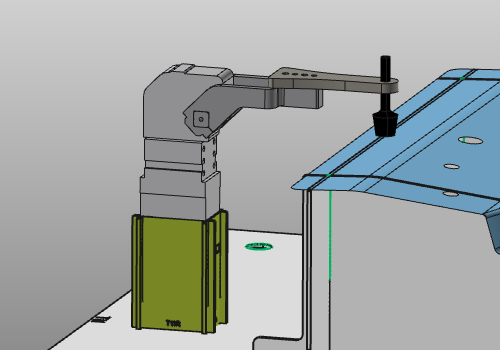
Workpiece fixtures
Plate fixtures
Fixtures are resources that usually have one simple function: to support and carry workpieces or assembled workpieces during some manufacturing or other operation. There are many different types of fixtures, from simple product support up to extended functionality with various kind of fixation and clamping utilities.
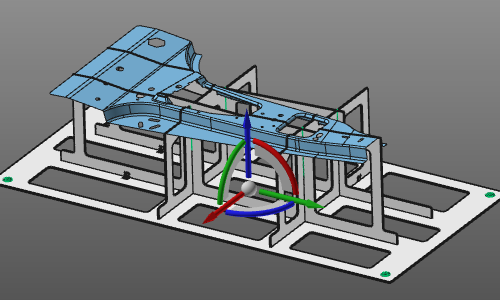
One type of fixture is designed and built from 2D plates. Support plates that carry the product are assembled together through interlocking the plates to build a stable structure. Placing this assembly in several slot holes on a base plate completes the fixture.These cost effective plate based fixtures are easy to design and can be manufactured and assembled very fast.
There are different types of plate based fixtures to select from, when designing it.
| Type | Description | |
|---|---|---|
| Standard fixture | Standard fixture with base plate and support plates. The support plates are to carry the workpiece in Z-direction. | 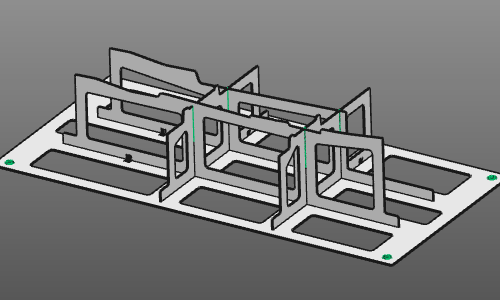 |
| Fixture without base plate | The standard fixture without the base plate. Only the support plates are designed. | 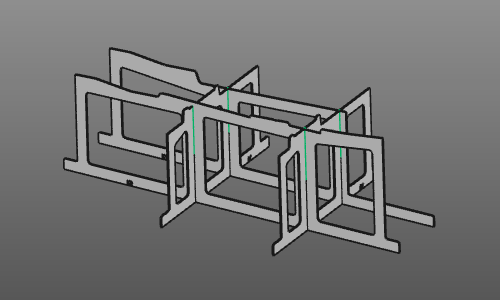 |
At initial creation, system default parameters are applied to build the fixture. It consists of a base plate, which orientation is derived from the Manipulator’s U-direction. The base plate size is determined from a system computed bounding box around the workpiece. It furthermore has table mounting holes at each of four corners. The workpiece lies on support plates. Two of these are created, equally distributed, in both length (X plates) and width (Y plates) direction.
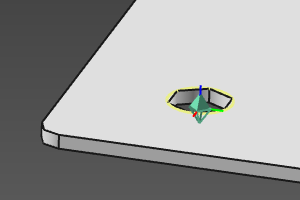
Mechanical plug adapters are defined at each mounting hole in the corner of the base plate to place the fixture easily onto some table in the (workcell) layout. The hole is represented by a circle and the actual hole in the base plate.
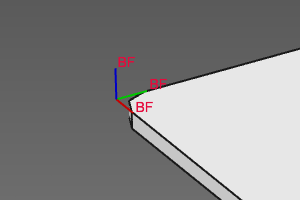
A base frame is placed at the main corner, for example to be used as reference in the offline programming.
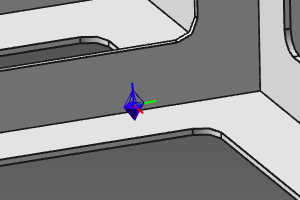
A mechanical socket adapter is created as a reference for the position of the workpiece in the fixture.
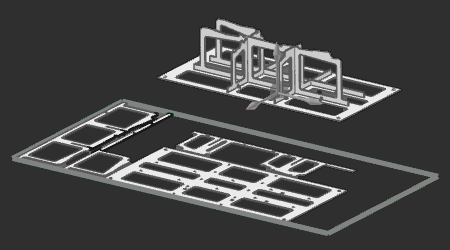
For manufacturing purpose the fixture plates can be nested onto material sheets. With the use of predefined sheet dimensions and other parameters, the system will automatically nest all the fixture plates, to be ready for the offline programming of the plate contours in any cutting operation.
The result of the nesting operation is a 2D layout of the fixture plates.
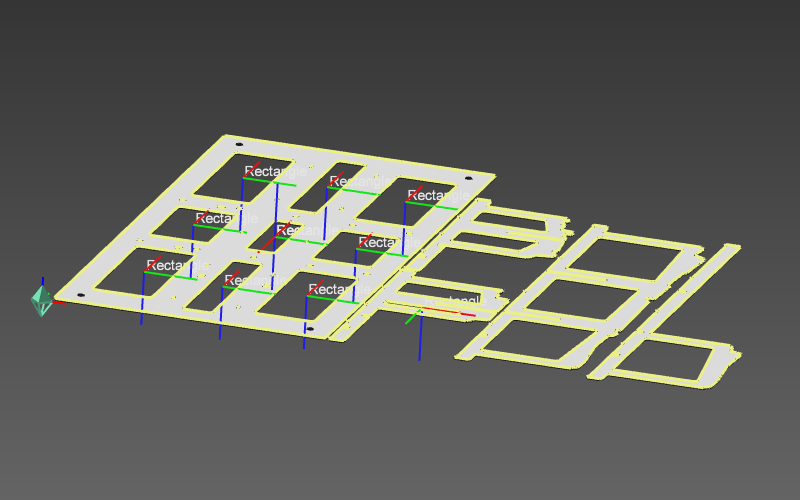
To prepare this nested layout for OLP purposes for manufacturing, the result includes a mechanical plug adapter to easily position it in the manufacturing machine.
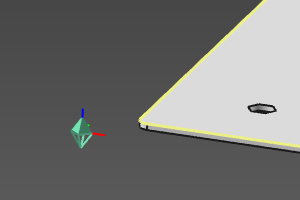
And for all contours the process geometry is created to support the tool path generation.
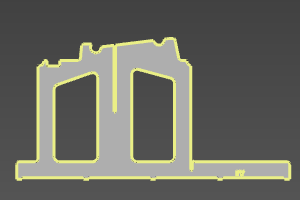
Besides the supporting plates to hold the workpiece, the fixture can be extended with tower objects. A tower is an assembly of plates that build a pillar-based structure. These towers typically are used to mount a clamp that fixes the workpiece tight onto the support plates.